

Someone Has to Open the Gate: How Local Races Are Growing Trail Running

Editor’s Note: At SWVA Running, we believe some of the most meaningful experiences in endurance sport happen far from the biggest starting lines. They happen on local trails, in small towns, at aid stations staffed by volunteers, and in the moments when someone discovers a place, or a version of themselves, they did not know before. That is why we wanted to share this perspective from guest writer Tom Shank. Drawing on participation data, industry research, and observations from the broader trail-running community, Tom explores why local races matter, how they create pathways into the sport, and why small does not have to mean insignificant. His perspective reflects much of what we see happening on the trails here in Southwest Virginia.
Growing Local Trail Running and the Changing Shape of Recreational Endurance
Something interesting is happening in recreational endurance sport, and much of it is happening far from enormous expos, national championships, corporate branding campaigns, and stadium-scale events. It is happening at county parks, state forests, greenways, mountain trailheads, municipal recreation areas, and small pieces of private land opened for a weekend. A few hundred people arrive early on a Saturday morning. There may be a folding registration table, some handwritten signs, a timing mat, several coolers, a local running-store tent, and volunteers filling paper cups or cutting bananas. Somebody gives last-minute instructions, and then everyone disappears into the woods.

For a long time, this kind of event was easy to think of as the small end of the endurance business, a stepping stone toward something larger, more professional, more prestigious, or more heavily produced. I increasingly think that gets the relationship backward. The scale, accessibility, informality, community, and relationship with place are not necessarily deficiencies waiting to be corrected. They may be the reason people are showing up. And increasingly, they are showing up in numbers large enough that trail running can no longer be dismissed as a niche corner of endurance sport.
The long-term numbers make the shift difficult to ignore. One of the largest attempts to measure trail-race participation, The State of Trail Running 2022, produced by RunRepeat in collaboration with World Athletics, examined more than 15 million finishes from nearly 117,000 races in 127 countries. It found that trail-race participation had increased 231 percent over the decade leading to 2022 and that trail running represented 15.8 percent of race finishes in the dataset. [1] That figure is now several years old and should not be mistaken for a snapshot of the sport in 2026, but it establishes the longer direction of travel. The movement toward trails was already well underway.

More recent data suggest that movement has continued. In September 2025, UTMB World Series and Strava released a joint analysis showing that the number of athletes uploading trail runs during the first half of 2025 was twice what it had been during the same period three years earlier. Participation in UTMB Index races was 2.4 times the comparable 2022 level, producing more than 800,000 race starts in six months. The number that interests me most, though, is not the total. Forty-two percent of those runners were participating in their first trail-running event. [2]
That begins to look less like established trail runners simply racing more often and more like new people finding their way into the sport. They are not necessarily entering through the extreme end, either. Roughly two-thirds of participants in UTMB Index races competed at marathon distance or shorter. Strava reported an average trail-run distance of 9.7 kilometers with 213 meters of elevation gain. Only about one percent of UTMB Index participation occurred at the 100-mile distance. [2] Trail running may still be represented in the popular imagination by an ultrarunner climbing an enormous mountain after twelve hours on his feet, but for most people the entrance is much less dramatic.
That entrance often looks like a small race close to home.
Small races are easy to overlook because endurance sport tends to advertise itself through scale. Major marathons shut down city streets. Championship events have television coverage, enormous starting fields, celebrity athletes, sponsor villages, and elaborate finish lines. Yet the broader American endurance market is built to a surprising degree on much smaller events. RunSignup’s 2025 RaceTrends report analyzed more than 12.2 million registrations across more than 97,000 events. Eighty-seven percent of those races had fewer than 500 participants, and those small races accounted for 38 percent of participants. [3]

Those numbers cover the broader endurance market rather than trail running alone, but they say something important about the environment in which local trail races exist. Small events are not statistical leftovers surviving underneath a market that belongs entirely to giant races. They are a central part of recreational racing.
They are growing, too. RunSignup found that events with fewer than 500 participants grew 13.6 percent between 2019 and 2023, another 10 percent between 2023 and 2024, 6.4 percent between 2024 and 2025, and 6.6 percent again during the first half of 2026. [4] Large races are growing as well. In fact, races with more than 5,000 participants grew 8.2 percent during the first half of 2026, faster than any other size category measured by RunSignup. [4] This is not a story about people rejecting marathons, destination races, or major sporting events. Those can thrive at the same time. The more interesting development is that small races do not have to become large races in order to matter.
A trail race with 200 runners can remain a trail race with 200 runners.

That scale creates a different kind of sporting experience. The registration area might consist of a folding table. The course markings might have been placed by the race director the afternoon before. Volunteers might be working an aid station at a trail intersection they have run past hundreds of times themselves. The person answering registration emails on Thursday might be standing ten feet beyond the finish line on Saturday. People know the park. They know the difficult climb, the creek crossing, the place runners tend to miss a turn, the section that turns to mud after rain.
It would be easy to look at all of this and see an event that has not yet become fully professionalized. Maybe the folding table is part of the product.
There is still plenty of commerce involved. Race directors charge entry fees. Registration platforms charge fees. Timing companies have to be paid. Permits, insurance, equipment, transportation, land access, food, and labor all cost money. Shoe companies are enormous businesses. Trail running has not escaped the economy simply by moving into the woods. But the social character of the transaction can feel different. A runner may feel less like she is entering an extensive branded ecosystem and more like she is paying someone to create an opportunity to run somewhere interesting with other people.
There is at least some reason to think that the distinction between small and large carries meaning beyond racing. Gallup’s 2025 polling found that 95 percent of Americans viewed small business positively, compared with 37 percent for big business. Seventy percent expressed a great deal or quite a lot of confidence in small business, compared with 15 percent for big business. Among adults aged 18 to 34, confidence in big business was just 10 percent. [5] None of that means people are signing up for trail races as some kind of protest against corporate America. It does suggest that smallness no longer automatically reads as second-rate. Small can mean local, independent, familiar, and human in scale. In recreational sport, those things can have value of their own.

The modest size of many trail races also makes experimentation easier. A person does not have to decide that trail running is about to become a central part of her identity. She does not need to begin with a destination race, an ultramarathon, a plane ticket, or a serious commitment of money and vacation time. She can enter a race forty minutes from home and see what happens.
That matters in an economic environment where younger adults are paying close attention to discretionary spending. Deloitte’s 2025 Gen Z and Millennial Survey included more than 23,000 respondents across 44 countries. Forty-eight percent of Gen Z respondents and 46 percent of millennials said they did not feel financially secure. More than half reported living paycheck to paycheck, more than a third said they struggled to cover monthly living expenses, and more than 80 percent identified day-to-day finances or their long-term financial future as sources of anxiety or stress. [6]
People have not stopped buying experiences, but experiences compete for limited money and time. A local race has an obvious advantage when it does not require airfare, multiple hotel nights, extensive travel, or weeks built around a destination weekend. More importantly, the cost of finding out whether you actually like the sport can be fairly low.
Maybe you discover that you hate roots, mud, climbing, and running downhill. Fine. You have learned something.
Maybe you love it.
Then an enormous recreational world has opened.
That first experience matters because sports reproduce themselves through first experiences. Before someone becomes a trail runner, somebody has to get her onto a trail. Trail running has an unusually simple recruiting proposition because a runner already possesses most of what she needs to begin. The terrain changes. Pace changes. Foot placement matters more. Hills get steeper. Weather can become more consequential. Rocks and roots demand attention that pavement does not. But none of those things has to be mastered before someone is allowed to participate.

A road runner can enter a trail 10K and figure it out while they are doing it. They can walk the climbs. They can slow down through technical sections. They can finish much later than they expected. They can discover that their normal road pace means almost nothing. They can trip over a root. None of this automatically means they do not belong there.
The invitation is almost embarrassingly simple: You run? Come run over here.
This is growing trail running and that may be one of trail running’s most effective recruiting mechanisms. A person does not have to announce that she is becoming a trail runner before she participates. She only has to agree to run a race on Saturday. The identity can come afterward.
The current participation data become even more interesting when younger runners and women are considered. Across RunSignup’s broader endurance market, women represented 53 percent of participants in 2025, while runners aged 18 to 29 accounted for 17.9 percent, the largest share the platform had recorded for that age group since 2017. [3] During the first half of 2026, women represented 53.2 percent of participants and the young-adult share rose to 21.8 percent. RunSignup cautions that age distributions can shift during the year because participation is seasonal, so that number should not be treated as a final annual figure. [4] Still, the direction is notable.

The trail-specific numbers are more striking. UTMB and Strava reported that female participation in UTMB Index trail races during the first half of 2025 was 2.6 times the comparable level three years earlier. Among Gen Z women, Strava recorded a 6.5-fold increase in the number uploading trail runs globally over the same comparison period. [2]
The data cannot tell us exactly what is drawing younger women onto trails. Cost, community, social media, outdoor culture, run clubs, race availability, or some combination of them may all be involved. What the numbers can tell us is simpler: more women are showing up, and younger women in particular are showing up fast.
Once people arrive, the social structure of trail running may help keep the door open behind them. UTMB and Strava reported a nearly 20 percent increase over three years in the share of trail runs performed as group activities, along with a 31 percent increase since 2019 in the share of Strava runners who belonged to a club. [2] The American Trail Running Association’s 2025 survey points in a similar direction. Its sample was much smaller, just over 500 members of ATRA’s national audience, so it should not be treated as representative of every American trail runner. But within that group, 69 percent said they felt part of a trail-running community. When asked how they had built or expanded that community, the most common answer was running trail races, selected by 82 percent, followed by social media and volunteering at races. [7]
That suggests the race is doing more than serving a community that already exists. It can help create one.
One person signs up and tells somebody else. They run together. Somebody finds another race. Another friend comes along. One of them volunteers. Somebody discovers a weekly trail group. Eventually five people are standing at a trailhead where there used to be one.
The activity creates the next participant.
This kind of growth does not require a national organization to manufacture community from the top down. It can happen because people keep inviting one another back into the woods. That is particularly important in a sport that manages to combine accessibility with real difficulty.
Calling trail running accessible can sound strange because trail running is often extremely hard. A mountainous 25K can dismantle a competent road runner. A technical 50K can require hours of climbing, descending, eating, drinking, managing temperature, solving problems, and continuing after the experience has become deeply uncomfortable. Hundred-mile races sit at an extreme edge of recreational endurance sport.
But difficulty and accessibility are not opposites. Trail running can have a wide entrance and an almost unlimited ceiling. Someone can begin with a local 5K and never move beyond short-distance races. Somebody else can eventually run fifty or one hundred miles through mountains. Both are participating in the same basic activity.
The sport does not need to make the climb less steep in order to make the doorway wider. Rocks can remain rocks. Heat can remain oppressive. Rain can turn the trail to mud. A participant can spend the final miles wondering why she ever thought entering the race was a good idea. What can remain welcoming is the human environment around the difficulty.
That distinction matters especially when thinking about women and running. Creating a place where someone feels safe participating does not mean sanitizing the activity or removing discomfort, risk, competition, or challenge. The mountain does not need to become easier.

Physical safety involves straightforward practical questions. Does somebody know runners are on the course? Is there an aid system? Will somebody notice if a participant does not return? Is the location reasonably secure?
Social safety is different. Can someone participate without being patronized, harassed, hit on, judged, or treated as though she has wandered into somebody else’s sport?
There is another question underneath both: Do I have to become a particular kind of athlete before I belong here?
A healthy local trail-running community can answer no. Show up. Run what you can. Walk what you need to. Learn. Come back. You do not have to become a trail runner before being admitted to the trail-running community. You can become one by participating.
That is a remarkably easy door into an activity capable of becoming remarkably difficult.
And the difficulty is never entirely abstract because trail running is attached to place in a way many standardized sporting formats are not. A trail race is not simply a generic competition inserted into a location. The location often is the race.
The geology determines the climbs. Rain changes the footing. A creek creates a crossing. Tree cover alters the heat. A ridge produces the view. Fallen branches or washed-out sections change the course. A race director knows where runners are likely to take a wrong turn because she has been running there for years.
Two trail races of identical distance may feel almost nothing alike. In many sports, that lack of standardization would be a defect. In trail running, it creates discovery.
A state park becomes a race venue. A mountain two hours away becomes a weekend destination. A section of forest that previously meant nothing becomes personally significant because somebody suffered through a climb there. Runners begin accumulating places as much as results. A relatively small geographic world starts to feel much larger.
That may help explain why a race with 200 people can feel significant without needing to become a race with 2,000. Its value does not come only from the size of the field, the prestige of the event, or the quality of the production. Part of the value is getting access to a place, being tested by it, and then carrying some relationship with that place away afterward.
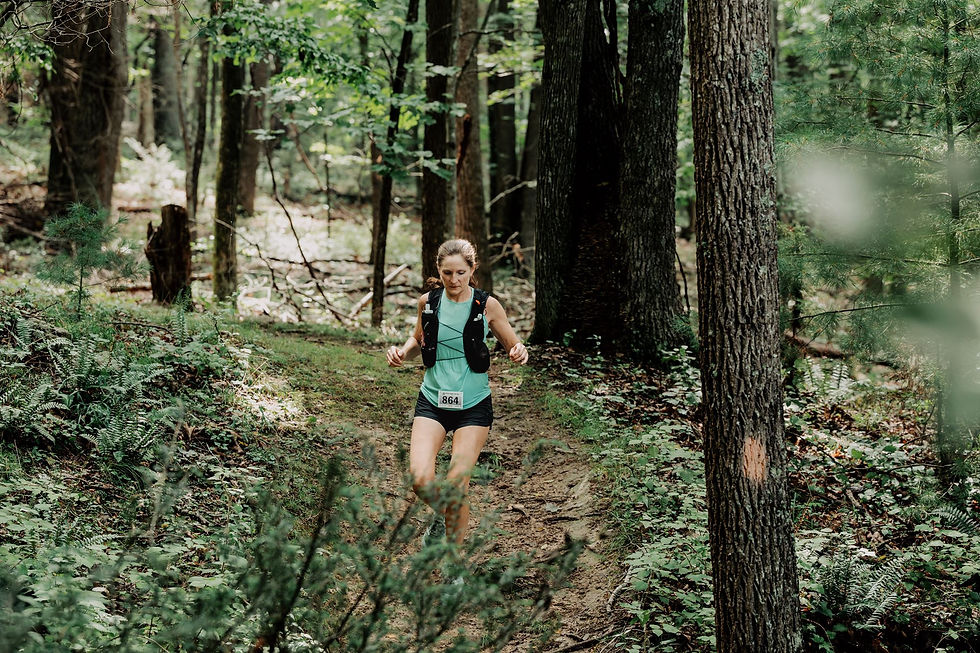
In Southwest Virginia, that relationship between running and place is especially visible. The region offers the kind of landscape where a relatively short drive can produce an entirely different running experience. A crushed-gravel rail trail along the New River asks something different of a runner than the steep singletrack of Crystal Springs Recreation Area. The trails and overlooks of Breaks Interstate Park create another experience entirely. In Damascus, trails converge on a small town whose identity has long been tied to outdoor recreation and the mountains surrounding it.
Local races give runners a reason to experience these places differently. Someone may visit a park for the first time because there is a race there, then return months later to run, hike, camp, or bring family and friends. A runner who might never otherwise have driven to a particular Southwest Virginia community suddenly knows its trails, its climbs, its overlooks, and perhaps the volunteers who handed them food at an aid station when they were having a difficult day.
That relationship works in the other direction, too. Many of the people creating these events already know these places intimately. Race directors, volunteers, local runners, park staff, and community partners bring knowledge that cannot easily be reproduced by dropping a standardized event into a location. They know where the trail gets muddy after heavy rain, where runners will need encouragement, which climb is harder than it looks on a map, and which overlook is worth stopping for even when the clock is running.
In that sense, a local trail race does more than use Southwest Virginia as its backdrop. It introduces people to a place. The distance may be what gets someone to the starting line, but the place is often what they remember afterward.
Southwest Virginia is only one example of this relationship between local races, landscape, and community. Similar communities are forming around trails and races across the country, each shaped by its own terrain and the people who choose to run there. Their growth does not have to come at the expense of other forms of endurance sport. It simply gives people another way, and another place, to find challenge, connection, and belonging.
This is why I do not think the most useful story about trail running is that it is defeating some other form of endurance sport. That would make its importance dependent on somebody else’s decline. Road races remain. Major marathons remain. Obstacle races remain. Functional-fitness competitions have grown. Ultras have expanded. Run clubs have become culturally important. Recreational athletes simply have more ways to pursue difficulty, fitness, competition, adventure, accomplishment, belonging, and identity than they did a decade ago.
Trail running has grown inside that crowded landscape because it combines qualities that do not often exist together. It can be local without feeling insignificant. Small without feeling unsuccessful. Welcoming without being easy. Social without requiring an enormous organization. It can offer competition to someone who wants competition and solitude to someone who wants solitude. A participant can run five kilometers or one hundred miles without ever really leaving the same sport.
Most importantly, someone does not have to become a trail runner before entering the trail-running world.
She can become one by showing up.
It is easy to be impressed by scale. Ten thousand people crossing a starting line looks important. National sponsorship looks important. Championship banners, professional broadcasts, famous athletes, enormous festival areas, elaborate timing systems, and sold-out destination races are important.
But importance can look different.
It can look like a race director standing beside a folding table in a county park early on a Saturday morning. Two hundred people are gathering nearby. Some are experienced ultrarunners. Some are recreational runners trying trails for the first time. Someone is worried about the hills. Someone bought trail shoes last week. Someone came because a friend talked her into it. Someone will finish near the front. Someone will walk half the climbs.

Soon they will all disappear into the woods.
There is something important in that scene, and not because large races are disappearing or corporations have somehow stopped mattering or everyone suddenly wants to become an ultrarunner. The more constructive story is that local trail running is creating another doorway into endurance sport: geographically rooted, human in scale, socially reproducible, relatively easy to enter, and nearly unlimited in the difficulty it can eventually provide.
The evidence increasingly suggests that people are walking through it. Trail-race participation expanded dramatically over the previous decade. More athletes are recording trail runs than only a few years ago. First-time racers make up a substantial share of current participation. Women, particularly younger women, are appearing on trails in rapidly growing numbers. Small races remain structurally important to the American endurance market, while trail races themselves appear to be one of the places where trail-running communities are built.
People still want hard things. They want exhaustion and adventure, accomplishment and belonging, discovery and stories. Trail running does not have to manufacture those things.
The woods already contain them.
Someone simply has to open the gate.
Race Series Referenced in This Essay
SWVA — Southwest Virginia Running
Upstate Running — Upstate Race Series
Photo Credits
Selected photographs courtesy of Ruben Felix Visuals.
Additional photographs by Limestone Research Office.
Infographics
Limestone Research Office
About the Author
Tom Shank writes about endurance sport, outdoor recreation, and the communities that form around them. His work is interested less in elite competition than in why ordinary people choose difficult things, what keeps them coming back, and the places and people they find along the way. More of his race and endurance writing can be found at ShankGym, with additional essays, field research, and other projects at the Limestone Research Office and Silent Outpost.
References
[1] Andersen, Jens Jakob. “The State of Trail Running 2022.” RunRepeat, December 3, 2022, updated December 10, 2022. Research conducted in collaboration with World Athletics. Dataset: 15,653,063 finishes from 116,947 races in 127 countries; elite runners excluded.
[2] UTMB World Series & Strava. “UTMB World Series Announces Strategic Collaboration with Strava, and Releases Joint Data Story on the Evolution of Trail Running.” September 10, 2025. Includes Strava activity data and UTMB Index race-participation data comparing the first half of 2025 with the same period three years earlier.
[3] RunSignup. “The State of the Industry: The 2025 Race Trends Report Is Here!” February 2, 2026. Based on more than 97,000 race events and 12.2 million registrations.
[4] RunSignup. “2026 Midyear Race Trends Update.” June 22, 2026. Based on 6.9 million registrants from December 1, 2025 through May 31, 2026; includes race-size growth and demographic comparisons.
[5] Gallup. “How Do Americans Feel About Business?” Originally published June 27, 2022; updated April 24, 2026. Includes Gallup’s June and August 2025 measures of confidence in and views of small and big business.
[6] Deloitte Global. 2025 Gen Z and Millennial Survey. Published 2025. Survey of 23,482 Gen Z and millennial respondents in 44 countries; fieldwork conducted October 25–December 24, 2024.
[7] Hobbs, Nancy. “Spring 2025 Trail Runner Survey Results.” American Trail Running Association, July 15, 2025. Survey of more than 500 respondents from ATRA’s national audience, conducted May–June 2025.


Comments